Geopolitics & Markets
US-China AI Chip War 2026: New Tariffs, Export Controls, and What It Means for Your Portfolio
The Trump administration is reshaping the US-China AI chip war with new tariffs, relaxed export controls, and a Taiwan trade deal. Here’s the investor playbook.
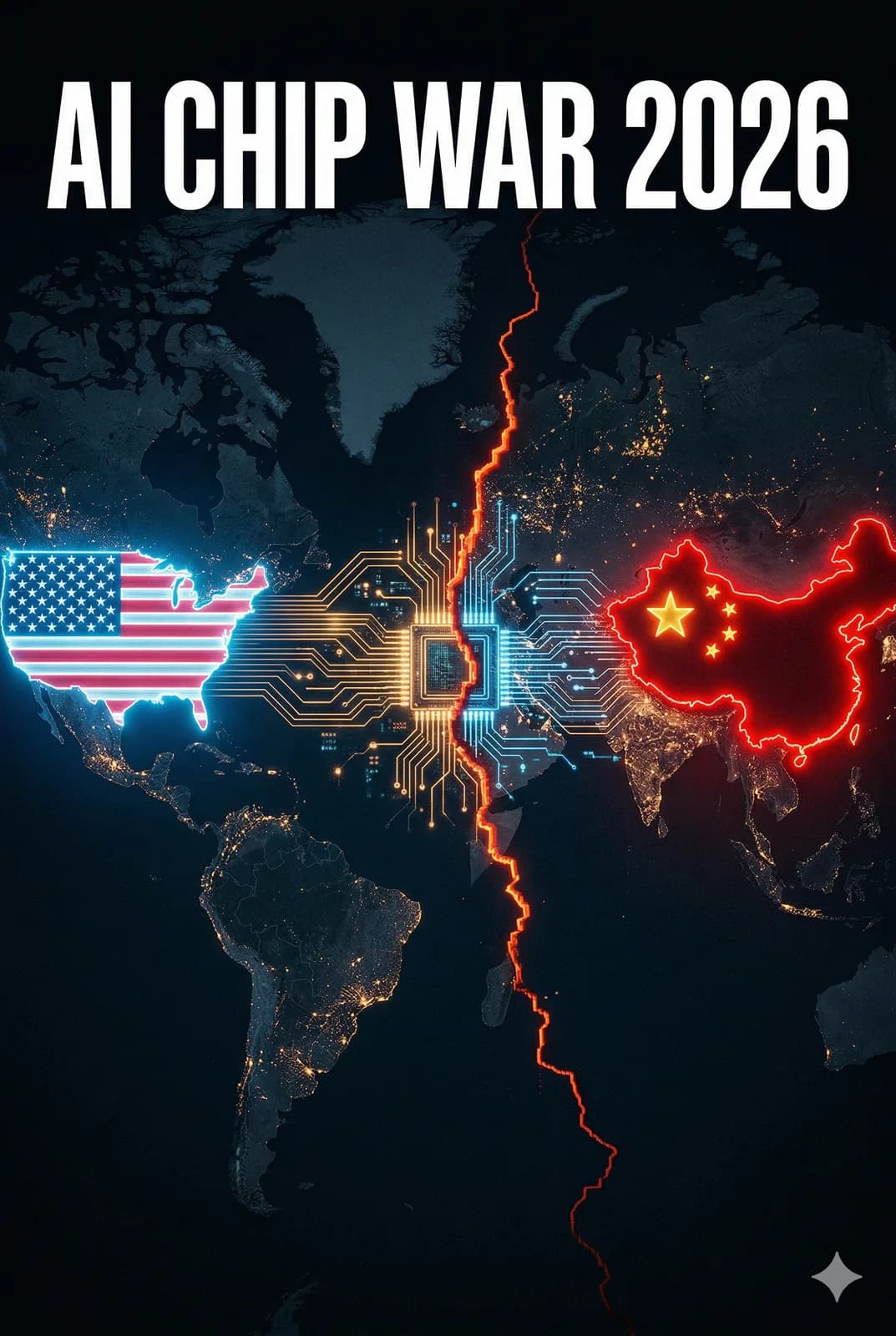
The technology cold war between the United States and China has entered its most complex phase yet. The rules are shifting. The stakes — measured in trillions of dollars of economic output, hundreds of billions in market capitalization, and the long-term trajectory of global AI leadership — have never been higher. And for investors, understanding the new landscape is not optional.
The Policy Pivot: From Blanket Bans to Case-by-Case Licensing
For much of 2023 and 2024, the US approach to AI chip exports was characterized by increasingly comprehensive restrictions. The Biden administration’s export control framework effectively blocked the most advanced semiconductors from reaching Chinese buyers. The Trump administration has taken a more transactional approach: in January 2026, it shifted from the blanket restriction model to a case-by-case licensing framework for certain advanced AI chips destined for China. More significantly, Nvidia H200 and AMD MI325X GPUs are now available for sale to Chinese buyers — subject to a 25% fee payable to the US government.
This is a meaningful policy shift. The H200, Nvidia’s previous-generation flagship training chip, was considered too sensitive to export just eighteen months ago. The decision reflects the administration’s judgment that revenue generation and trade relationship management outweigh the marginal security cost of allowing these chips into the Chinese market.
Hyperscaler capital expenditure, first quarter
The Demand Side Nobody Is Restricting
Export controls are a story about who is allowed to buy. It is worth keeping in view how large the demand is that nobody is restricting at all.
In the first quarter of 2026, Microsoft, Alphabet, Amazon and Meta together spent $129.8 billion on property and equipment, up from $71.9 billion in Q1 2025 — an increase of 80.5%, and roughly 8x the $16.1 billion those same four spent in Q1 2018. Those figures come from their own SEC filings and are in our hyperscaler capex tracker. They are total capex rather than an AI-only line, because no filing discloses one.
This reframes the policy debate in a useful way. The four largest American buyers of AI infrastructure are adding roughly $58 billion of incremental quarterly spending year on year, entirely inside the export control perimeter. Whatever the licensing regime does to the Chinese addressable market, it is operating at the margin of a domestic buildout that is compounding at close to 30% a year over eight years and accelerating.
Two consequences follow for positioning.
For Nvidia and AMD, China policy is an option on the upside, not the base case. Relaxation adds addressable market; re-tightening removes it. Neither changes the trajectory of the buildout that generates the majority of the revenue. Sizing a semiconductor position primarily off export-control headlines means trading the smaller variable.
For the equipment makers, the fragmentation is the trade. ASML, Lam Research, Applied Materials and KLA sell into fab construction regardless of which government is subsidising it. Redundant regional supply chains mean more fabs producing the same volume of chips — structurally more equipment sold per unit of end demand. That is the rare case where geopolitical inefficiency is directly revenue-accretive to a supplier.
The 25% Tariff Twist
Simultaneously, the administration imposed a 25% tariff on advanced computing chips manufactured abroad and then re-exported to third countries. This creates an asymmetric incentive structure: it effectively taxes the global chip intermediary trade while protecting domestic AI infrastructure investment. For Nvidia, AMD, and Intel, the incentive is clear — sell domestically, manufacture domestically, or route through US government-approved channels.
The Taiwan dimension adds another layer. A new US-Taiwan trade agreement signed in January 2026 gives Taiwanese chipmakers — primarily TSMC — preferential tariff treatment on semiconductors and manufacturing equipment, in exchange for commitments to invest $250 billion in US manufacturing capacity. TSMC’s Arizona fab expansion is the centerpiece of this deal.
Supply Chain Fragmentation: The New Normal
The deeper story beneath the policy headlines is the structural fragmentation of the global semiconductor supply chain. The clean, efficient globalized system that allowed a chip designed in California, manufactured in Taiwan, packaged in Malaysia, and sold in China is over. What is replacing it is a more expensive, more redundant, and more geopolitically managed system of regional supply chains.
This has two important implications for investors. First, the cost of semiconductor production is rising permanently — raising the floor for semiconductor pricing and benefiting companies with the scale to absorb higher fixed costs. Second, the investment thesis for semiconductor infrastructure is strengthening. The CHIPS and Science Act’s domestic incentives, combined with the Taiwan trade agreement’s investment commitments, are directing an unprecedented flow of capital into US and allied-nation semiconductor manufacturing. Companies providing equipment, materials, and services for this buildout — ASML, Lam Research, Applied Materials, KLA — are benefiting from a structural rather than cyclical demand driver.
China’s Response: Huawei and Domestic Champions
China has not been passive. Huawei’s Ascend AI chip line has made significant advances, and China’s domestic semiconductor industry — led by SMIC, Cambricon, and a range of state-backed startups — is receiving massive government investment. However, the reality is that China’s domestic chip ecosystem remains approximately two to three generations behind the global frontier. The export controls, even in their modified 2026 form, have meaningfully constrained China’s access to the most advanced compute.
The Investment Implications
US semiconductor equipment manufacturers represent perhaps the cleanest investment expression of the supply chain reshoring thesis. Their equipment is required regardless of which country is building the fabs, and their technology leads are protected by export controls that also apply to competitors.
Nvidia and AMD face a complex picture. The relaxation of some export restrictions improves their addressable market in the near term but introduces ongoing policy uncertainty. Any further policy tightening could create meaningful downside risk.
TSMC represents a unique case — simultaneously the world’s most critical technology asset and a geopolitical flashpoint. Its US expansion reduces concentration risk but introduces execution risk.
Intel’s effort to reestablish itself as a leading-edge manufacturer, supported by CHIPS Act funding and the broader reshoring incentive structure, represents a high-risk, high-reward bet on US manufacturing renaissance.
What We Would Watch Instead of Headlines
Policy in this area changes faster than any portfolio can be repositioned, and most of the coverage is reaction to announcements that take quarters to affect a single income statement. Three observable series do more work than the news flow.
Hyperscaler capex growth. The rate of change, not the level. Growth ran 30.7% in Q1 2024, 62.3% in Q1 2025 and 80.5% in Q1 2026. A deceleration here would hurt Nvidia and AMD far more than any plausible export-control decision, because it removes demand rather than reallocating it.
Equipment order books versus fab announcements. Announced fabs are policy theatre until equipment is ordered. The gap between the two is where the reshoring thesis either becomes revenue or stays a press release.
TSMC’s Arizona utilisation, not its Arizona capacity. The $250 billion investment commitment is a headline number attached to a multi-year schedule. Capacity built is not capacity yielding, and leading-edge yield ramps are where this thesis will actually be tested.
FAQ
Does China still get access to advanced AI chips in 2026?
Partially. The framework shifted in January 2026 from blanket restriction to case-by-case licensing, with Nvidia H200 and AMD MI325X GPUs available to Chinese buyers subject to a 25% fee payable to the US government. The most advanced current-generation parts remain restricted, and the licensing regime can be tightened again without new legislation.
How much does the China market matter to Nvidia and AMD?
Less than the headlines imply relative to the domestic buildout. The four largest US hyperscalers increased their combined quarterly capital expenditure by $57.9 billion year on year in Q1 2026 alone. That incremental domestic spending, inside the control perimeter, is the dominant revenue driver; Chinese access is a swing factor on top of it.
Is China catching up in semiconductors?
Huawei’s Ascend line and SMIC’s process progress are real, and state investment is substantial. The consensus assessment remains that China’s domestic ecosystem sits roughly two to three generations behind the leading edge, and the binding constraint is lithography equipment rather than chip design. That constraint is the one export controls actually address.
Who benefits most from supply chain fragmentation?
Semiconductor capital equipment suppliers, because duplicated regional capacity means more tools sold for the same volume of chips produced. Their technology leads are also protected by the same export controls that constrain their competitors’ customers.
The Bottom Line
The US-China AI chip war is not over. It has not even reached its final form. The policy environment will continue to evolve as the Trump administration balances trade objectives against technology security concerns, as China accelerates its domestic capability, and as the global AI infrastructure buildout intensifies the strategic value of advanced compute. For investors, this is a decade-long structural story, not a quarterly news cycle. The chip war is the most important geopolitical economic story of the 2020s. Make sure your portfolio reflects that.
Stay ahead of the markets. — AI Capital Wire Team