Geopolitics & Markets
Lockheed Martin vs RTX vs Northrop Grumman: Best Defense Stock 2026
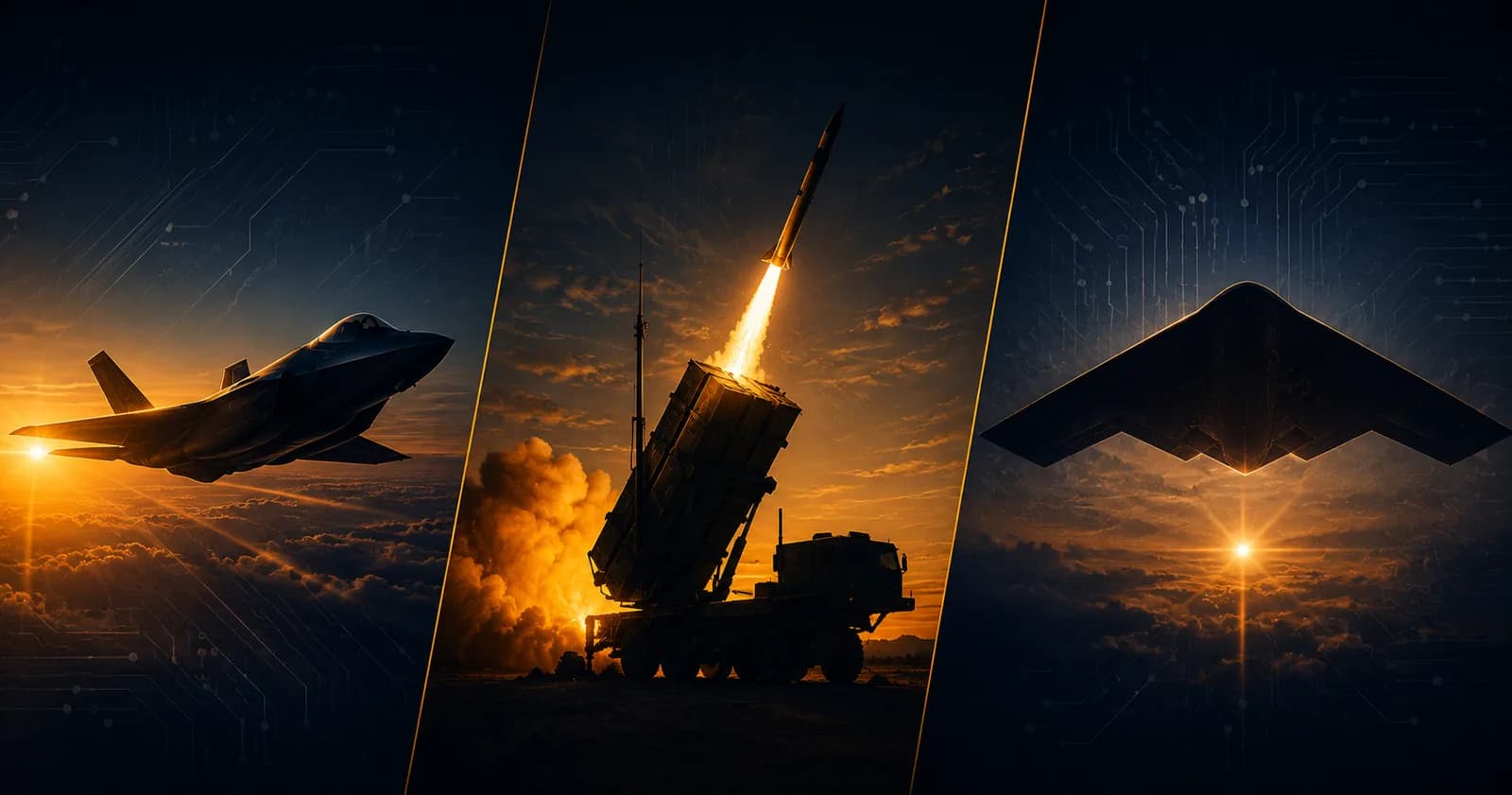
LMT, RTX and NOC hold ~$378B of market cap between them and about 60% of major U.S. weapons-system dollars. Which of the three primes is the better buy in 2026.
This article is for informational purposes only and does not constitute investment advice. AI Capital Wire holds no positions in the companies discussed at the time of publication.
Key Takeaways
- The fact: LMT, RTX and NOC combine for ~$378B in market cap and roughly $199B in FY2025 revenue — capturing an estimated 60% of major U.S. weapons-system dollars.
- Why it matters: The Pentagon’s FY27 budget request is heading toward $895B, with priority on missile defense, hypersonics and nuclear modernization — directly funneling capital to these three primes.
- The action: For income choose LMT (2.7% yield, F-35 monopoly). For growth choose NOC (B-21, Sentinel ICBM). For diversification choose RTX (commercial aero kicker).
European NATO defence spending
Why This Comparison Matters
Defense is one of the few sectors where the customer is legally constrained from defaulting and the demand curve is set by geopolitics, not the business cycle. In 2026, with NATO members ratifying a 3% of GDP defense floor, U.S. lawmakers pushing the Pentagon budget toward $895B, and Asia-Pacific rearmament accelerating, the structural tailwind is the strongest it has been since the Cold War.
According to SIPRI’s latest military expenditure data, global defense spending crossed $2.7 trillion in 2024 — the steepest year-over-year rise since 1988. Three U.S. primes capture the lion’s share of that wallet for advanced weapons systems: Lockheed Martin (LMT), RTX Corporation (RTX) and Northrop Grumman (NOC).
But they are not interchangeable. Each is a different bet. This is the head-to-head breakdown.
Quick Comparison Table
| Metric (FY2025) | LMT | RTX | NOC |
|---|---|---|---|
| Revenue | ~$74B | ~$83B | ~$42B |
| Revenue Growth YoY | +5% | +7% | +8% |
| Operating Margin | ~10.5% | ~9.5% | ~11% |
| Backlog | ~$176B | ~$220B | ~$84B |
| Market Cap | ~$115B | ~$185B | ~$78B |
| Forward P/E | ~18x | ~22x | ~20x |
| Dividend Yield | ~2.7% | ~2.0% | ~1.5% |
| 5-Year Dividend Growth | ~7% CAGR | ~5% CAGR | ~10% CAGR |
| Pure-Play Defense % | ~95% | ~55% | ~85% |
Source: Company 10-K filings, Yahoo Finance, AI Capital Wire estimates as of Q1 2026.
LMT — The F-35 Monopoly
Lockheed Martin LMT is the world’s largest defense contractor and the closest thing the sector has to a monopoly. It is the sole producer of the F-35 Lightning II — the only Western 5th-generation multi-role stealth fighter at scale, with 17 international customers and a program lifetime value the Pentagon now estimates above $1.7 trillion.
Programs & Moat
- Aeronautics (~40% of revenue): F-35, F-16 Block 70, F-22 sustainment.
- Missiles & Fire Control: Patriot PAC-3, THAAD, Javelin, HIMARS rockets, Long Range Hypersonic Weapon (LRHW / “Dark Eagle”).
- Rotary & Mission Systems: Sikorsky (Black Hawk, CH-53K), Aegis combat system.
- Space: Orion crew vehicle, GPS III satellites.
Bull Case
- F-35 backlog secured through 2030+; international orders accelerating post-Russia invasion (Germany, Switzerland, South Korea, Finland).
- Missile demand surge: Patriot and Javelin inventories being rebuilt globally, multi-year contracts locked in.
- Most defensive name in the sector — pure-play defense (~95% of revenue), reliable dividend grower.
Bear Case
- F-35 sustainment costs have ballooned, drawing congressional scrutiny; GAO continues to flag operating-cost overruns.
- Heavy single-program concentration — F-35 alone is roughly 30% of revenue.
- Limited growth optionality compared to NOC’s nuclear modernization pipeline.
RTX — Scale Plus Commercial Aerospace
RTX Corporation RTX is the most diversified of the three, formed from the 2020 merger of Raytheon and United Technologies. Roughly 45% of revenue comes from commercial aerospace (Pratt & Whitney engines and Collins Aerospace), giving it a kicker that LMT and NOC don’t have.
Programs & Moat
- Raytheon Defense (defense): Patriot air defense, NASAMS, AMRAAM, Standard Missile family (SM-2/3/6), Tomahawk, StormBreaker.
- Pratt & Whitney: GTF engines on Airbus A320neo, F135 engine for F-35 (powered by LMT’s airframe), military engines.
- Collins Aerospace: Avionics, interiors, mechanical systems on virtually every commercial widebody.
Bull Case
- Largest backlog in industry at ~$220B — visibility into 2030.
- Commercial aero recovery from Boeing/Airbus delivery cycle is a multi-year revenue tailwind.
- Air defense (Patriot, NASAMS) is the single hottest weapons category globally — Ukraine, Israel, Taiwan and Gulf states all backordered.
Bear Case
- Pratt & Whitney GTF engine recall has cost the company over $5B in cash since 2023; aftermarket impact still unfolding.
- Commercial cyclicality dilutes the “defensive” defense profile — recession risk hits Pratt and Collins.
- Lower margins than NOC; integration complexity post-merger remains a drag.
NOC — Stealth Bombers and Nuclear Modernization
Northrop Grumman NOC is the smallest of the three by revenue but the highest-margin and arguably the highest-growth optionality. It is the sole prime contractor on two of the most important U.S. defense programs of the next decade.
Programs & Moat
- B-21 Raider: Next-generation stealth bomber, replacing the B-2 and B-1B fleets. First aircraft already flying; full-rate production ramps later this decade.
- LGM-35A Sentinel: Sole supplier of the U.S. ground-based nuclear deterrent ICBM replacement (Minuteman III successor). Program total estimated at $140B+ over its lifetime.
- Mission Systems: Triton, Global Hawk, advanced radars, electronic warfare.
- Space: NGI (Next Generation Interceptor), launch vehicles, satellite payloads.
Bull Case
- B-21 and Sentinel together represent the largest U.S. strategic modernization wave since the 1980s — a multi-decade revenue tailwind.
- Highest operating margin of the three (~11%) and fastest revenue growth (~8% YoY).
- Strongest dividend growth profile (~10% CAGR over 5 years), even if starting yield is lowest.
Bear Case
- Sentinel program is in a Nunn-McCurdy breach — cost overruns have already triggered DoD review; program could be restructured.
- B-21 production ramp risk: classified program, less visibility than F-35 for investors.
- Smaller scale means less diversification within the portfolio — single-program slip hurts more.
Head-to-Head — Who Wins on What
| Category | Winner | Why |
|---|---|---|
| Best for Income | LMT | Highest yield (2.7%), most reliable defense pure-play. |
| Best for Growth | NOC | Fastest revenue growth + B-21/Sentinel multi-decade pipeline. |
| Best for Margins | NOC | ~11% operating margin, highest in the group. |
| Best for Diversification | RTX | Commercial aero + defense smooths cycles. |
| Best for Backlog Visibility | RTX | ~$220B — the largest in industry. |
| Best for AI & Hypersonics | LMT | Long-Range Hypersonic Weapon, autonomous mission systems lead. |
| Best for Nuclear & Strategic | NOC | Sole supplier of B-21 and Sentinel ICBM. |
| Best for Air Defense Cycle | RTX | Patriot/NASAMS/SM-family demand uncapped. |
The Verdict — Which One to Buy?
If you want one stock for the next 5 years: NOC
Northrop offers the best combination of growth, margins and asymmetric upside through B-21 and Sentinel. The Nunn-McCurdy risk is real but the program is too strategically critical to cancel — restructure, yes; cancel, no. Highest expected return.
If you want income and defensive resilience: LMT
Lockheed is the closest thing to a “blue chip” in defense. F-35 is irreplaceable, the dividend is a quarterly check you can count on, and the international demand pipeline runs deep through 2030+. Lowest beta of the three.
If you want the diversified industrial blue chip: RTX
RTX is the right pick if you also want exposure to the commercial aerospace cycle. The $220B backlog gives multi-year visibility, and the Patriot/missile portfolio is arguably the strongest single product line in the industry. Best for portfolios that already hold pure defense plays and want to add a broader industrial.
The pragmatic answer: own all three via an ETF
If you can’t decide — and most investors shouldn’t bet on a single weapons-program outcome — buy the basket through ITA (iShares U.S. Aerospace & Defense ETF), XAR (equal-weight) or SHLD (Global X Defense Tech). You get all three primes plus secondary exposure to GD, HII, LHX and HEI.
For a deeper guide on choosing between defense ETFs, see our companion piece on how to hedge your portfolio against a Taiwan conflict, which covers ITA, XAR and SHLD allocations in detail.
What’s Next — Catalysts to Watch
- Q2 2026: Pentagon FY27 budget submission to Congress — line items on missile defense, hypersonics and nuclear modernization will move all three names.
- Summer 2026: NATO Summit — ratification of 3% GDP defense floor, multi-year impact on European orders for Patriot (RTX), F-35 (LMT) and AESA radars (NOC).
- Q3 2026: B-21 production-rate decision — material upside catalyst for NOC if accelerated.
- Ongoing: Sentinel restructuring outcome — bear-case risk for NOC if program cost is contained but production rate slips.
- Earnings cadence: All three report quarterly — watch book-to-bill ratios above 1.2x as confirmation of sustained demand.
Frequently Asked Questions
Which defense stock has the highest dividend yield? LMT currently leads with a yield around 2.7%, versus RTX at ~2.0% and NOC at ~1.5%. LMT also has the longest history of consecutive dividend increases among the three. Is RTX safer than Lockheed Martin? Not necessarily. RTX has more diversified revenue (45% commercial aero), which cuts both ways — it smooths defense-budget cycles but adds airline-cycle exposure. LMT is more defensive in a recession but more concentrated in the F-35 program. They protect against different risks. Will a future U.S. administration cut defense spending? Historically, defense budgets are remarkably stable across administrations because authorization is multi-year and most weapons programs have bipartisan support tied to district-level jobs. Even in moderate-cut scenarios, the modernization wave (B-21, Sentinel, hypersonics, missile defense) tends to be protected. Risk is more around mix than total. What’s the best defense ETF as an alternative to single stocks? Three solid options: ITA (iShares U.S. Aerospace & Defense, market-cap weighted — heavy LMT/RTX/GE Aerospace), XAR (SPDR equal-weight — more balanced exposure across the supply chain), and SHLD (Global X Defense Tech — newer, includes Palantir, AeroVironment and other defense-tech names).
Bottom Line
The U.S. defense complex is in a multi-decade upcycle driven by Pacific deterrence, NATO rearmament and nuclear modernization. LMT, RTX and NOC each capture that tailwind differently. Pick the one that matches your portfolio’s missing exposure — or own all three through a defense ETF and let the budget cycle compound.
Stay ahead of the markets.
— Lucas Gil Gonzalez, AI Capital Wire
About the author: Lucas Gil Gonzalez is the founder and lead analyst at AI Capital Wire, a financial intelligence publication covering the intersection of artificial intelligence, geopolitics and global markets. He writes for institutional investors and serious retail capital allocators. Connect on LinkedIn →