Finance & Markets
Federal Reserve Investments: Essential 2026 Guide
With policy at 3.75% and inflation above target, every asset class is trading off the Fed. How rate moves transmit into stocks, bonds, the dollar and real assets — and what to hold at each stage.
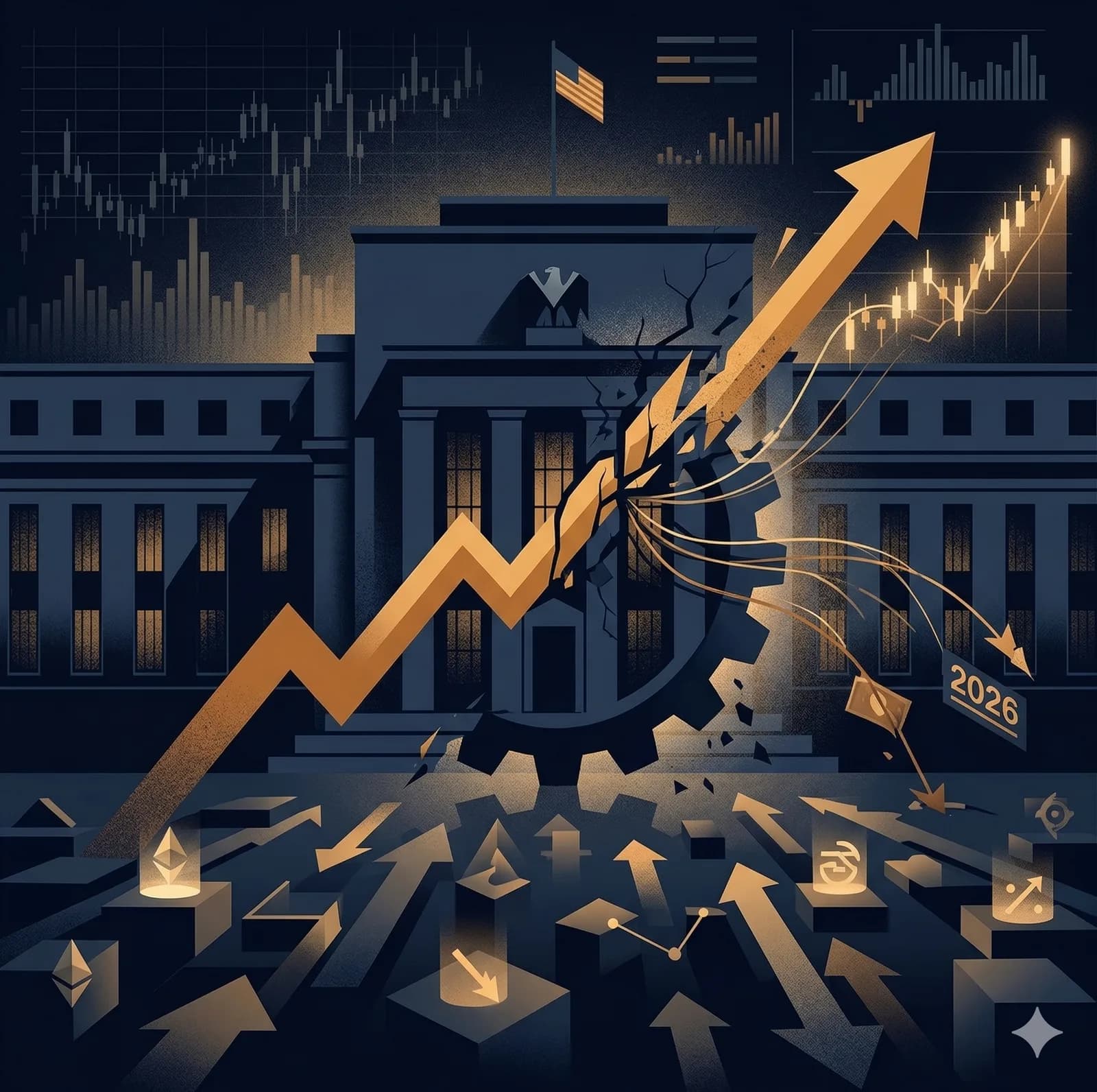
Federal Reserve investments decisions are the most powerful macro force affecting your portfolio in 2026. Every rate move by the Fed ripples through stocks, bonds, currencies, and real assets — whether you track it or not. With rates at 3.75%, inflation above target, and FOMC minutes due this week, understanding how Federal Reserve investments policy works is no longer optional for serious investors.
Key Takeaways
- Every asset class reacts to the Fed: When rates rise, bonds fall, growth stocks reprice lower, and the dollar strengthens. When rates fall, the opposite happens. Knowing which direction the Fed is moving — and why — is the most reliable macro input available to any investor.
- The 2026 context: The Fed is holding at 3.75% despite political pressure and recession fears. Markets are pricing just one rate cut for the year. That “higher for longer” environment has direct, measurable consequences for how you should allocate capital right now.
- The mechanism, not just the outcome: Most investors know rates affect markets. Very few understand the exact transmission mechanisms — discount rates, credit spreads, earnings multiples, currency effects — that determine which assets win and lose in each rate environment. This guide covers all of them.
Federal Reserve Investments Impact: The Foundation Every Investor Needs
The Federal Reserve is the central bank of the United States. It has two primary mandates: keep inflation near 2% and maintain maximum employment. To pursue those goals, it controls the federal funds rate — the interest rate at which banks lend to each other overnight. That single number, set by the Federal Open Market Committee (FOMC) at its eight scheduled meetings per year, is the most consequential input in global financial markets.
Why does one interest rate in Washington affect your tech stocks, your bond portfolio, your mortgage, and the currency in your wallet? Because money has a cost. When the Fed raises rates, borrowing becomes more expensive across the entire economy — for corporations, consumers, governments, and investors. When it cuts, borrowing becomes cheaper. That cost of money flows through every valuation model, every corporate earnings projection, and every investment decision made anywhere on earth where capital can move freely.
The critical insight most retail investors miss: the Fed doesn’t just affect markets when it acts. It affects markets continuously — through its language, its projections, and the market’s expectations of its future behaviour. In 2026, understanding Powell’s battle to maintain Fed independence while managing a politically charged rate environment is as important as understanding the rate itself.
Federal funds target rate
How the Fed Affects Stock Prices: The Four Mechanisms
The relationship between the Federal Reserve and stock prices operates through four distinct channels. Understanding each one separately — rather than treating “Fed = good/bad for stocks” as a binary — is what separates sophisticated investors from reactive ones.
1. The Discount Rate Effect
Every stock is theoretically worth the present value of its future cash flows, discounted back at an appropriate rate. When the Fed raises rates, that discount rate rises — which mechanically reduces the present value of future earnings. This effect is most pronounced on growth stocks, which derive most of their value from earnings far in the future. A company whose earnings are expected in 2030 or 2035 is far more sensitive to discount rate changes than a company generating strong cash flows today.
This is why NVDA, MSFT, and other high-multiple AI stocks sold off when the Fed began hiking in 2022 — and why they partially recovered when the hiking cycle appeared to end. In 2026, with rates still at elevated levels, high-multiple tech stocks remain exposed to any further tightening. Meanwhile, value stocks and dividend payers — whose earnings are near-term and well-anchored — are relatively more insulated.
2. The Earnings Effect
Higher rates increase the cost of debt for corporations. A company with significant floating-rate debt sees its interest payments rise directly when the Fed hikes. This compresses profit margins without any change in revenue. In the current environment, small and mid-cap companies — which tend to carry more variable-rate debt than large caps — face disproportionate earnings pressure. This partially explains why the Russell 2000 has underperformed the S&P 500 significantly in the high-rate era of 2024–2026.
3. The Economic Growth Effect
Higher rates slow economic activity — that is their purpose when inflation is above target. Slower economic growth means lower consumer spending, lower corporate revenues, and ultimately lower earnings across the broad market. The Fed’s current challenge in 2026 is that the oil shock from the Hormuz disruption has created inflationary pressure it cannot address with monetary policy, while simultaneously slowing demand. As Moody’s recession model now sits at 49%, the Fed’s growth impact is being felt in real time.
4. The Risk Premium Effect
When risk-free rates (Treasury yields) rise, the hurdle rate for equity risk rises with them. If a 3-month Treasury bill yields 4.3% with zero risk, investors require a higher return from equities to justify the additional risk. This “risk premium compression” reduces the multiples investors are willing to pay for stocks. In 2026, the 10-year Treasury yield at 4.3% is competing directly with equity valuations in a way that was impossible during the near-zero rate era of 2020–2021.
How the Fed Affects Bonds: The Inverse Relationship Every Investor Must Know
The relationship between interest rates and bond prices is one of the most important — and most frequently misunderstood — mechanics in investing: when rates rise, bond prices fall. When rates fall, bond prices rise. This relationship is not a market opinion — it is mathematical.
Here is why. A bond issued at 3% yield becomes less attractive when new bonds are issued at 4%. To compensate, the price of the existing 3% bond must fall until its effective yield matches the market rate. The longer the bond’s maturity, the more sensitive its price is to rate changes — a concept called duration.
| Bond Type | Duration | If Rates Rise 1% | If Rates Fall 1% | 2026 Positioning |
|---|---|---|---|---|
| 3-Month T-Bill | ~0.25 years | -0.25% price | +0.25% price | BlackRock’s top pick — safe yield at 4.3% |
| 2-Year Treasury | ~1.9 years | -1.9% price | +1.9% price | Hold — sensitive to Fed pivot signals |
| 10-Year Treasury | ~8.5 years | -8.5% price | +8.5% price | BlackRock underweight — deficit risk |
| 30-Year Treasury | ~20 years | -20% price | +20% price | Avoid — maximum rate sensitivity |
In the current environment, BlackRock explicitly recommends underweighting long-duration Treasuries despite the recession fear — because persistent inflation and the US fiscal deficit create upward pressure on long rates regardless of what the Fed does with short rates. Short-term Treasuries offer the best risk-adjusted positioning: you capture the 4.3% yield without taking duration risk.
Federal Reserve Investments Impact by Sector: The Complete Map
| Sector | Rates Rising ↑ | Rates Falling ↓ | Why |
|---|---|---|---|
| Banks (JPM, BAC, GS) | Win | Lose | Net interest margins expand as lending rates rise faster than deposit rates |
| Growth Tech (NVDA, MSFT) | Lose | Win | High multiples = high duration = maximum discount rate sensitivity |
| Real Estate (REITs) | Lose | Win | High debt loads + valuations compete directly with Treasury yields |
| Utilities (NEE, DUK) | Lose | Win | Bond-like dividend yields become less attractive vs Treasuries when rates rise |
| Energy (XOM, CVX) | Mixed | Mixed | Oil price (geopolitical) dominates over rate effects; moderate debt loads help |
| Defense (LMT, RTX) | Resilient | Resilient | Government contracts are rate-insensitive; geopolitical drivers dominate |
| Consumer Discretionary | Lose | Win | Higher mortgage and credit card rates reduce discretionary spending directly |
| Gold (GLD) | Historically loses | Wins | Rising real rates increase the opportunity cost of holding non-yielding gold — but geopolitical fear can override this in 2026 |
US 10-Year Treasury Yield — Live Chart
Bull Case vs. Bear Case: Fed Policy in 2026
Bull Case — Fed Cuts in H2 2026 (40%)
- Oil shock resolves: If the Strait of Hormuz reopens, energy prices normalise, inflation falls back toward target, and the Fed gains the room to cut. Goldman Sachs maintains a year-end S&P 500 target of 7,600 based on this scenario.
- Labour market deteriorates: If unemployment rises meaningfully from 4.4%, the Fed’s employment mandate overrides the inflation concern. One or two rate cuts become politically unavoidable.
- Market impact: A Fed pivot — even signalled, not executed — triggers a sharp re-rating of growth stocks, REITs, and long-duration bonds. The AI theme regains momentum as discount rates fall.
Bear Case — Fed Holds or Hikes (60%)
- Tariff inflation persists: BlackRock and Fink both warn that tariff-driven price pressure is structural, not transitory. If CPI stays above 3%, the Fed cannot cut without losing credibility. The Fed already held at 3.75% against market expectations of cuts.
- Stagflation trap: Slowing growth + sticky inflation = Fed paralysis. It cannot cut (inflation) and cannot hike (growth). Higher for longer becomes the default — the worst environment for long-duration assets.
- Market impact: Continued multiple compression in tech, further underperformance in REITs and utilities, and sustained outperformance in short-term Treasuries, banks, and energy names.
Federal Reserve Investments Policy in 2026: Three Things Every Investor Must Know
The 2026 Fed environment is unusual in three ways that every investor needs to understand before making allocation decisions.
Political pressure without precedent. The Trump administration has publicly pushed for rate cuts, creating a situation where Fed independence is itself a market variable. Powell’s explicit pushback against political interference has been interpreted by markets as a signal that the Fed will not bend — which paradoxically gives credibility to its “higher for longer” stance, even if it creates short-term market volatility.
Geopolitical inflation the Fed cannot fix. The oil price spike from the Hormuz disruption is a supply-side shock. The Fed’s tools — rate hikes and cuts — affect demand, not supply. This means the Fed is essentially watching inflation run above target due to forces outside its control, while being politically pressured to cut and economically pressured to support a slowing economy. The FOMC minutes due this week will reveal the extent of internal disagreement about how to navigate this impossible triangle.
The AI capex question. Morgan Stanley estimates $3 trillion in AI infrastructure investment through 2028, with 80%+ still ahead. This capital expenditure cycle is largely rate-insensitive — hyperscalers are spending because competitive necessity demands it, not because capital is cheap. But the valuation of AI companies is highly rate-sensitive. In a higher-for-longer environment, AI ETFs and semiconductor names face multiple compression even as the underlying business continues to grow — a distinction investors frequently miss.
The Practical Framework: How to Position Your Portfolio Around the Fed Cycle
Professional investors don’t react to Fed decisions — they position for them in advance. Here is the four-phase framework used by institutional portfolio managers to align allocations with the rate cycle.
Phase 1 — Peak Rates (Current environment: 2026)
The Fed has stopped hiking but has not yet cut. Short-term rates are at their highest. This is the optimal moment for short-term Treasuries (capture the yield without duration risk), banks (peak net interest margins), and defensive dividend payers with low debt. Avoid long-duration bonds and high-multiple growth stocks. Begin building positions in assets that will benefit from the first cut — but do not chase the pivot prematurely.
Phase 2 — First Rate Cut Signal
The most explosive moment for markets. Even a 25 basis point cut — or even just the signal of one — triggers immediate repricing across the yield curve. Long-duration bonds rally. REITs and utilities re-rate sharply higher. Growth stocks stage a significant recovery. The investors who positioned in Phase 1 capture this move. Those who waited for confirmation buy after the move has largely happened.
Phase 3 — Active Cutting Cycle
The Fed is cutting rates at multiple consecutive meetings. This is the best environment for growth stocks, REITs, and long bonds. It is typically accompanied by economic recovery expectations, which also supports cyclicals. Bank stocks often give back some Phase 1 gains as net interest margins compress. This phase historically produces the strongest equity returns.
Phase 4 — Rates Near Zero / Ultra-Low
The previous cycle of 2020–2021. Artificially cheap money inflated all asset prices simultaneously — the “everything rally.” Returns were exceptional across the board but were ultimately unsustainable. The lesson of 2022 is that Phase 4 creates the conditions for a painful Phase 1 repricing when inflation inevitably returns. We are living through that repricing now.
Where to Position Your Portfolio: The Fed-Aware Allocation for 2026
Given the current Phase 1 environment — peak rates, no cuts imminent, inflation sticky — here is how to structure a Fed-aware portfolio in 2026:
Overweight short-term Treasuries (3–12 month maturities). At 4.3% yield with near-zero duration risk, short T-bills are the best risk-adjusted opportunity in fixed income. This is BlackRock’s explicit top pick for the current environment. Use SHV (iShares Short Treasury Bond ETF) or BIL (SPDR Bloomberg 1-3 Month T-Bill ETF) for liquid exposure.
Overweight banks and financials selectively. JPMorgan, Goldman Sachs, and Wells Fargo are reporting Q1 earnings this week. Watch the net interest margin guidance closely — this is the number that tells you how much longer banks can sustain their rate-environment advantage. Strong NIM guidance is a green light; compression signals the peak-rate advantage is fading.
Maintain energy with discipline. Integrated oil majors — CVX, XOM, COP — are relatively rate-insensitive because oil price is the dominant driver of earnings. They provide portfolio ballast in the current environment. But manage the geopolitical premium exposure: a Hormuz resolution compresses oil prices faster than the Fed can affect equity multiples.
Hold AI selectively, not broadly. The AI infrastructure buildout is real and durable. But in a high-rate environment, multiple compression is ongoing. Focus on companies generating actual cash flow from AI — not just capex recipients. Broadcom (AVGO), TSMC (TSM), and companies with AI-driven cost reduction in their P&L are preferable to pure-play narrative stocks at elevated multiples.
Stay underweight long bonds and REITs until there is a genuine signal — not a hope — that the Fed is pivoting. The FOMC minutes this week will either confirm or challenge that thesis. If the minutes reveal more internal debate about cuts than the market expects, long bonds could rally sharply. If they confirm “higher for longer” unanimity, avoid them.
Frequently Asked Questions
How does the Federal Reserve impact your investments when it raises rates?
When the Fed raises rates, four things happen simultaneously: (1) the discount rate for future earnings rises, compressing stock multiples — especially in high-growth names; (2) bond prices fall as existing bonds become less attractive vs new higher-yield issuances; (3) borrowing costs rise for companies, compressing profit margins; (4) the dollar typically strengthens, pressuring multinational earnings and emerging market assets. Banks are the clear winners. Growth stocks, REITs, utilities, and long-duration bonds are the clear losers. Energy and defence tend to be relatively insulated because their drivers (oil prices, government contracts) are more powerful than rate effects.
What is the current Federal Reserve interest rate in 2026?
The Federal Reserve held the federal funds rate at 3.75% at its most recent FOMC meeting in March 2026. Our full analysis of that decision covers why the Fed held despite market expectations for a cut, and what Powell’s language signals about the path forward. Markets are currently pricing just one rate cut for the remainder of 2026, most likely in Q4 if inflation data improves materially.
Does the Federal Reserve directly control stock prices?
No — the Fed does not directly control stock prices. It controls the federal funds rate, which indirectly affects equities through the four mechanisms described above: the discount rate effect, the earnings effect, the economic growth effect, and the risk premium effect. The key word is “indirectly.” Stock prices are ultimately driven by earnings and multiples. The Fed affects the multiple (through the discount rate) and the earnings (through economic growth and borrowing costs). But other factors — geopolitics, technology cycles, corporate execution — can dominate the Fed’s influence in any given period. In 2026, the Hormuz oil shock has been a more immediate market driver than Fed policy for much of Q1.
Will the Fed cut rates in 2026?
Markets are currently pricing one rate cut in 2026, most likely in Q4. Goldman Sachs maintains this as its base case, alongside a year-end S&P 500 target of 7,600. BlackRock and Larry Fink are more cautious — Fink has explicitly said the Fed has no room to cut four or five times as markets previously hoped, because tariff-driven inflation makes premature easing dangerous. The FOMC minutes due this week will provide the clearest signal yet of internal debate on the timing. A Hormuz resolution that brings oil back below $90/barrel would dramatically improve the odds of an earlier cut. Our analysis of the Fed’s last hold covers the three scenarios in detail.
What assets perform best when the Federal Reserve holds rates high?
In a peak-rate, higher-for-longer environment like 2026, the historically strongest performers are: short-term Treasuries (capture yield without duration risk), bank stocks (expanding net interest margins), energy companies with low breakeven costs (rate-insensitive earnings), defence contractors (government contract revenues are rate-immune), and gold (which historically underperforms in rising rate environments but benefits from geopolitical safe-haven demand that is currently overriding that relationship). The consistent underperformers in this environment are long-duration bonds, REITs, utilities, and high-multiple growth stocks whose valuations are most sensitive to discount rate changes.
The Bottom Line
Understanding Federal Reserve investments policy is not a theoretical exercise — it is the most practical analytical framework available to any investor. Every allocation decision you make exists within a rate environment that the Fed has created. Ignoring that context is like sailing without checking the wind direction.
In 2026, the Fed is trapped between its dual mandate objectives in a way that creates unusual uncertainty. Inflation above target argues for holding or hiking. A slowing economy argues for cutting. Political pressure pushes toward cutting. Energy shock inflation resists monetary tools entirely. The resolution of this tension — likely determined in large part by whether the Hormuz situation resolves in the next 60 days — will be the most consequential macro event for your portfolio this year.
The investors who will perform best in this environment are the ones who have mapped their portfolio explicitly to the rate cycle phase — positioned for peak rates now, with a clear plan for how to reposition when the pivot comes. Not if. When. Because the Fed always eventually cuts. The question is always the timing — and in 2026, timing is everything.
For current Fed rate decisions and their immediate market impact, see our analysis of the March 2026 hold and the S&P 500’s reaction to Fed day. For broader recession context, see our stock market recession 2026 analysis.
Stay ahead of the markets. — AI Capital Wire Team
Lucas Gil Gonzalez
Founder & Lead Analyst, AI Capital Wire
Independent financial analyst covering AI markets, geopolitics, and energy. Focused on translating macro and geopolitical signals into actionable equity frameworks for serious investors. LinkedIn →